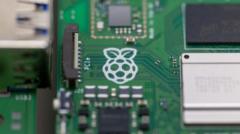
A green circuit board the size of a deck of cards sits on a cluttered workbench. It has no sleek aluminum casing. It does not look like the future of artificial intelligence. It looks like a spare part you might find in the back of a radio repair shop forty years ago. Yet, the tiny green board is pulsing.
Eben Upton originally wanted to solve a mundane problem. In 2012, he noticed that students applying to study computer science at the University of Cambridge had plenty of enthusiasm but zero practical experience. They knew how to use web browsers, but they did not know how computers actually worked. His solution was the Raspberry Pi. It was cheap. It was bare-bones. It was meant to be dropped, broken, re-coded, and understood. It was a teaching tool.
But people started buying them for everything else.
Now, look at the global markets. Wall Street is obsessing over massive data centers that consume enough electricity to power small cities. Tech giants are spending billions on monstrous microchips that run hot enough to fry an egg instantly. While the world stares at these titans, a quiet shift is happening at the bottom of the pyramid. The tiny British computer company just lifted its profit forecasts. Demand is not just growing; it is shifting shape.
The Shift From the Cloud to the Countertop
Consider a hypothetical engineer named Sarah. She works for a mid-sized logistics company managing a fleet of delivery trucks. A year ago, if Sarah wanted to use machine learning to predict when a truck brake was about to fail, she had to send thousands of data points into the cloud. The data traveled from the truck, through a cellular network, into a massive server farm, and back again. It took time. It cost money. If the network dropped in a rural area, the system failed.
Sarah does not use the cloud for that anymore. She screws a Raspberry Pi directly inside the truck dashboard.
The little board processes the data locally. It does not need a massive internet connection. It does not need a cooling system that rivals a commercial refrigerator. This is edge computing. It is the practice of running complex algorithms right where the action happens, rather than miles away in a server farm.
The numbers behind this shift are striking. Raspberry Pi recently announced that its full-year profitability is expected to exceed previous market expectations. This is not because hobbyists are buying more boards to build retro gaming consoles, though they still do that. It is because industrial buyers are purchasing them by the thousands to act as the eyes and ears of automated systems.
The company found itself in a sweet spot after its listing on the London Stock Exchange. The initial public offering gave them the capital to push forward, but the real driver is the sheer volume of businesses realizing that they do not need a sledgehammer to crack a nut. They do not need a million-dollar server to run a targeted AI model. They just need thirty-five dollars of silicon and some clever code.
The Physics of Scale
We have been conditioned to think that bigger is always better in technology. We watch announcements of massive neural networks with trillions of parameters. We hear about the staggering amounts of capital required to build the next generation of software.
But think about the physics of the situation.
Power consumption is the hidden wall of the AI revolution. A massive data center requires a dedicated power substation. The wires humming outside those buildings are thick, heavy, and expensive. The heat generated by those operations requires sophisticated liquid cooling infrastructure.
The Raspberry Pi 5 runs on a fraction of the power of a standard household lightbulb.
[Traditional AI Infrastructure] ---> Heavy Power Requirement ---> Cloud Dependent
[Edge AI Infrastructure]        ---> Low Power Requirement    ---> Local Processing
When a factory owner wants to install smart sensors across an assembly line to detect microscopic defects in real time, they cannot run a liquid-cooling tube to every single machine. They cannot afford the latency of sending a high-definition video feed of a conveyor belt up to a server three states away. They need the decision to happen in milliseconds. They need it on the factory floor.
The little British board became the default choice for these environments because it is open. If a developer does not like how the operating system handles a specific camera feed, they can rewrite the operating system. There are no corporate gatekeepers demanding a monthly subscription fee just to keep the hardware running.
This openness creates a strange kind of trust. In an industry dominated by proprietary ecosystems and secretive algorithms, a piece of hardware that lays all its circuits bare feels almost radical.
The Vulnerability of Being Small
It is easy to get swept up in the financial triumph of a raised forecast. The stock market loves a upward curve. But there is an underlying tension in this success story that many commentators miss.
By becoming an industrial darling, Raspberry Pi is stepping into a different kind of arena. Hobbyists are forgiving. If a supply chain crunch means a teenager has to wait three months to get a board for their robotics project, they might grumble on a forum, but the world keeps turning.
If a factory line shuts down because a component is unavailable, fortunes are lost.
The company has had to balance its dual identity. It is a charity-backed enterprise aimed at helping kids learn to code, but it is also a publicly traded corporation feeding the hunger of automation systems globally. If they lean too far into the corporate world, they risk losing the community that gave them their soul. If they ignore the corporate demand, they lose the revenue that funds their educational mission.
It is a delicate tightrope. The recent spike in demand for AI applications at the edge has accelerated this tension. Suddenly, everyone wants a piece of the low-cost computing pie. Competitors are circling, offering slightly faster processors or slightly cheaper manufacturing.
Yet, the competitive advantage of the Pi is not the silicon itself. It is the documentation. It is the millions of lines of forum posts where some engineer in Munich solved the exact same error code that an engineer in Tokyo is facing right now. You cannot manufacture that kind of community overnight with a venture capital fund.
The Invisible Network
Walk into a modern hospital, a modern farm, or a modern transit hub. You will not see the computers. They are tucked behind monitor mounts, zipped inside waterproof boxes under tractor seats, and zip-tied to the metal frameworks of train stations.
They are monitoring the temperature of vaccines. They are analyzing the acoustic signature of pig coughs to detect early signs of respiratory disease in livestock. They are counting passengers on platforms to optimize train schedules during rush hour.
This is the invisible network. It is an architecture built not on grand promises of general artificial intelligence that can write poetry or paint pictures, but on small, practical bits of code that do one thing perfectly, millions of times a day.
The financial markets are reacting to this reality. The raised profit forecast is a signal that the initial hype wave of the AI boom is maturing. The money is moving from the theoretical to the practical. The world is realizing that while training an AI model requires a supercomputer, running that model where it actually interacts with human lives requires something much humbler.
The workbench remains cluttered. The green circuit board blinks its tiny red LED light, completely indifferent to its stock price or the analysts debating its future in the high-rise offices of the City of London. It just keeps processing the data, one line of code at a time, proving that sometimes the biggest revolutions come in the smallest packages.